
The March Update
Back in India as I write this. You might remember from my last post that Anand and I got stuck in London for a few extra days because of *gestures at the world in general*, but we got back safely on the 9th, and since then, I’ve been busy with work, production stuff on In Your Skin and figuring out promotion etc.
This time around, we’ll have a quick rundown of news, but I’ve missed writing more elaborate essays in these newsletters (always one of my favourite things about doing newsletters in the first place), so I decided to expand on something below, about creative influences.
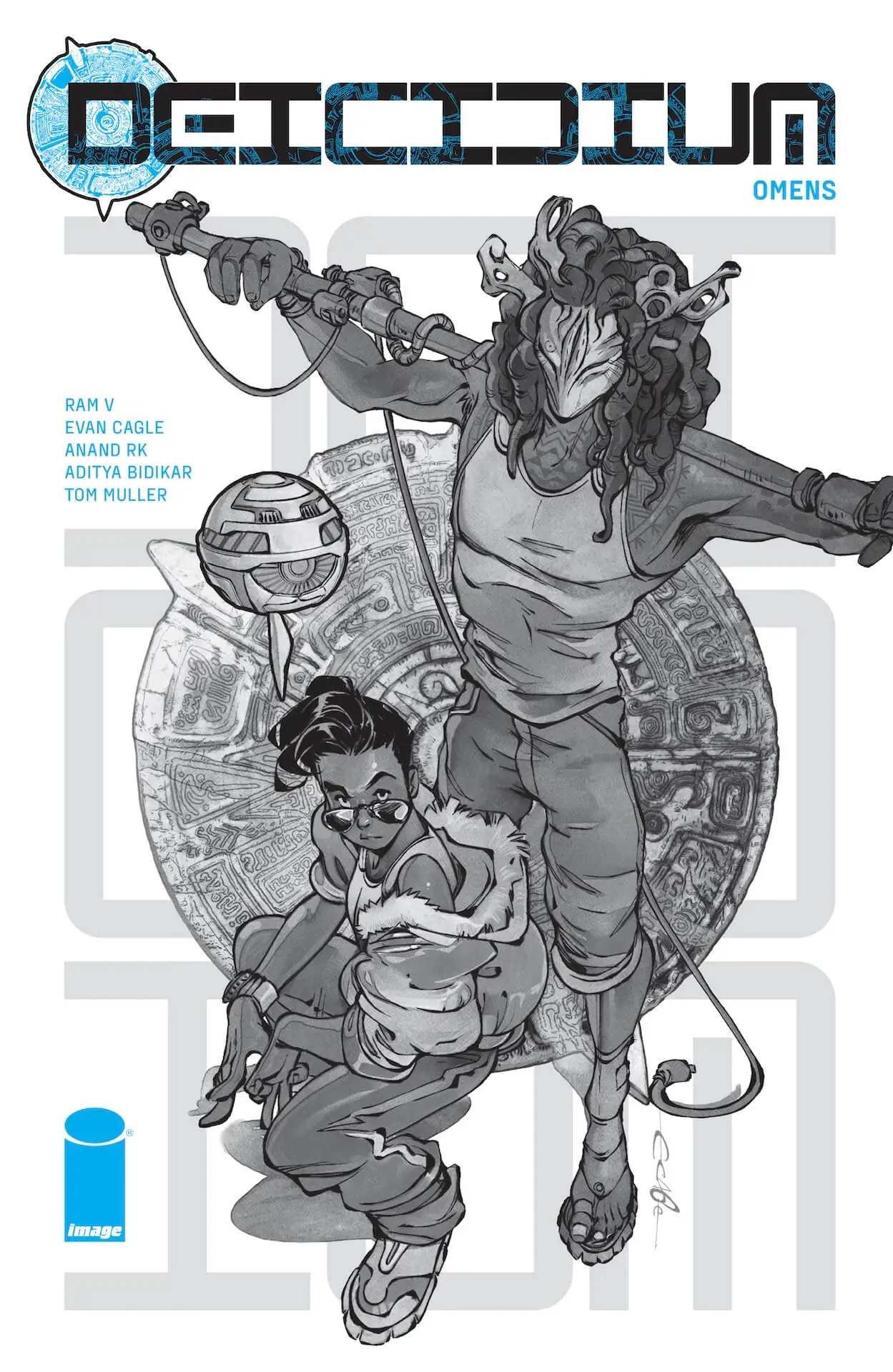
First in big news stuff, our big project with Morgen was announced – Deicidium, a new ongoing graphic novel project, written by Ram V, drawn by Evan Cagle and Anand RK, lettered by me, designed by Tom Muller, edited by Eric Harburn and Arnaud Tomasini, coming this year from Morgen in French and Image Comics in English. The exclusive announcement at the AV Club:
In a future rebuilt from the ashes of war, belief is no longer sacred – it’s monetized.
Humanity has entered a hard-won age of stability, governed by an unholy alliance between global corporations and newly engineered religions. Worship fuels the economy. Faith is power. Salvation is a product. Welcome to the industry of belief. That fragile balance shatters when the old gods return. Ancient deities of fire, wind, jaguars, love, war, and mischief awaken inside ordinary people, transforming neighbors and strangers into living gods. To the powers that be, they aren’t miracles – they’re threats.
The great faiths of the new world knew the old gods could one day return. And they planned for such an eventuality. 12 orphans were chosen, bestowed with gifts and taught to be faithless, loveless instruments without reward or remorse. The old gods have returned – and the 12 will be unleashed.
As old myths collide with a world built on manufactured faith, a brutal conflict ignites – one that will decide who controls humanity’s future, and whether salvation comes from those placed above us … or from within us. DEICIDIUM is a global epic from the multi-award-winning collaborations of Ram V, Evan Cagle, Anand Radhakrishnan with Tom Muller, Aditya Bidikar and more.
We’ve been working hard all week to send our 16-page preview, titled “Omens”, to print, which will be appearing in Image’s Free Comic-Book Day offering on May 2. Deicidium is also why Anand and I were in London earlier in this month, by the way, but more on that as things coalesce. Deicidium will be published as three 100-page graphic novels per year, and the first year will be drawn by Evan, while Anand will work on Year 2.
In Your Skin news:
Sami DeMonster interviewed Som and me about In Your Skin for her newsletter, The DeMonster Journal. She had some great questions, and Som and I both had a lot of fun answering them. For example, here’s Som and me on “why comics”:
Som: The sense of time is implicit in comic books. Consequently, there is a lot of freedom for the artist to guide his viewer’s engagement with the page. The more detail the artist adds, the more the artist slows down the moment for the reader. One doesn’t necessarily get that temporal flow in films. In films, the moment of horror is always fleeting and quite often doesn’t serve much beyond a certain shock value. In comics, that one moment is stretched in time for eternity. It can make the viewers obsess about it, almost transposing them into that moment as a lived experience.
Aditya: As Harvey Pekar once said, “comics are words and pictures. You can do anything with words and pictures.” The moment I was introduced to comics as an adult (with books like Watchmen, Uncle Sam, and Persepolis), I knew this was going to be my native medium. The level of audience participation available to comics as opposed to other visual mediums excites me. As for horror in comics, as Som says, you don’t have to immediately move on from an image in a comic. You can linger, get lost in the details. It can work on the visceral level of a gut-punch, as you’ll see a bunch of Som’s pages do in this book, but it can give you a lot more to chew on. There are tricks we can pull off in comics that I feel neither prose nor film can do.
There’s a whole lot more at the link.
Also, we have our first advance review from Elias Rosner. It’s an insightful write-up, and I’m glad the book is provoking such thought. Here’s a snippet:
As this is a very advanced review, I won’t go into any details – preserve the mystery and all that. Suffice it to say, the scene that got me was at the halfway point. It isn’t the most upsetting in the book – that honor goes to the final page – though it was, for me at least, a close second.
It is a vaguely tender, deeply sad, uncomfortable scene, fulfilling the comic’s remit of body horror in a very different, far more everyday way. A three-page sequence, visually reminiscent of the opening splash-page (after the poster,) bathed in red, the toned shading giving way to rough pencils. A far cry from the pages that precede and succeed it – full of grounded, somewhat bright color and full backgrounds.
If the opening is unsettlingly false – the fantasy Priyanka wills in her head as she dances – then this scene is unsettlingly true. It is her reality laid bare, conflicted and tense. A tension of her own making as she tries to make everything, everything, fit the the story she is telling herself: that she is the one she idolizes – in mind, in spirit.
In body.
More at the link.
One of the questions Sami asked in her interview was, What pieces of media influenced this series? Here’s my answer:
Cronenberg is an obvious influence – I watched The Fly at age nine and have been chasing that high ever since – but I feel a kinship with his spiritual children in the new French extremity, particularly Julia Ducournau, whose Raw and Titane are monumental works of body horror. While not influences, exactly, Eliza Clark’s Boy Parts and Alison Rumfitt’s Tell Me I’m Worthless were companions as I wrote the original outline, and because I prefer not to read fiction while I’m writing scripts, I either rewatched an episode of Deadwood – for the musicality of its dialogue – or read a poem by Lucia Perillo before I started the day’s scripting. I’m sure they’ve seeped into the writing somewhat.
Which got me thinking, What’s influence anyway?
I don’t think any serious artist simply cribs from their influences – it’s a far more nebulous connection. You will find traces of my influences in the book, as you might see traces of Moebius or Junji Ito in Som’s art. But that’s a matter of synthesis, and how style develops. You see something and you say, I’ll have that.
The primary ways in which influence works beyond your basic development, for me at least, are taste and permission.
First, my taste defines the way I will create art. As I mentioned up there, I watched The Fly when I was nine years old, and I haven’t been the same since. But what that did, more than influencing what I would end up writing, was to tell me what I wanted to see and read more of. The Fly made me a horror fan, because I felt horror could explore certain extremes of human experience other genres couldn’t – something I still feel to be true.
In many ways, there’s as much of The Cook, the Thief, His Wife and Her Lover in my writing as there is of The Fly or Ballard’s Crash. There are influences in terms of the musicality of dialogue, the flow of information in the way I put scenes together, or layering of subtext that come not from my liking specific works of art, but from the way they resonated with me and allowed me to access a part of myself I hadn’t managed to reach before. It’s less I want to do something like that and more I like that, and I want to do something that makes me feel like that.
And that brings us to the other way influence works, which is permission. Watching Ducournau’s Titane, my biggest reaction was, Oh, you can do that? And if she could do that, then I could do what I wanted to do as well. That’s how Boy Parts and Tell Me I’m Worthless influence me too – by giving me courage to explore topics that another part of me might be hesitant to delve into. Not tell that kind of story, but explore the kind of uncomfortable, vulnerable spaces those stories delve into. Making serious art without being genteel about it.
Both of these types of influence are inwards-looking, they are about me rather than about the influence. I always had a vague interest in the bodily, the baser parts of our being. But it’s watching these works of art that allowed me to think about what I’d like to do in that space.
A few weeks ago, I was in a discussion with a fellow artist who insisted that you had to compromise on personal vision if you wanted to make something popular. That if you wanted to make a “hit”, you had to adhere to accepted structures and formulae, give it that polished sheen.
I said that given the choice between those two things, I’d always choose the personal and weird over the popular and formulaic, but I added that I don’t think that’s a binary choice at all.
The most popular tv show of the last 20 years – the biggest hit, and the last show that was seemingly watched by the whole world at once – was Game of Thrones. And Game of Thrones is based on a series of books that are incredibly weird and personal – there’s a nerdy engagement with the structures and tropes of fantasy, there’s obsessive worldbuilding, there’s incredible violence, incest, body horror, and a repeated, uncomfortable engagement with power structures and how they impinge on the individual. That’s before you get to the three centuries of backstory and the loving, respectful history of several generations of incestuous Pharaoh archetypes. Even when the show deviates from the books, it remains a deucedly odd work of art to the end.
The biggest show of the century so far is a strange, personal vision that is absolutely not intended to please anyone. And yet it worked. That’s permission.
That felt good, didn’t it? A little return to the old days of topical rambling. I’ll be back in a few days with some more links, as we get more coverage of In Your Skin.
I have been told that I should repeat this a bit more. In Your Skin comes out on April 22nd, and you can pre-order with your local comic-book store by March 30th. Pre-orders are one of the most direct ways in which retailers know how many copies to order, so these affect sales a lot. If you’d like to read the book, let your comics store know!