
Adventures in Etymology (1)
The first in a series of etymological observations from recent reading.
Did you know the word laconic comes from Laconia, a region in Greece whose capital is … Sparta? You know, because the ancient Spartans were famed for being terse in their speech. Sardonic also comes from Sardinia, but there’s some debate on what the origin story is. Folk etymology says that ancient Sardinians had a ritual of killing old people while laughing (as an act of transforming death into birth, not because they were sadistic), but that’s … a lot. Some others say that there was a toxic Sardinian herb which, when ingested, would give the victim a particular kind of rictus grin. Who knows.
More from Ancient Greece – you might know agoraphobia as a fear of open places. The agora in question was the Ancient Greek marketplace, where Socrates and Diogenes would randomly berate strangers (I came across the term while reading about Greek philosophy).
When I told a friend this, he wondered if the Portuguese agora, meaning “now”, had the same origin. I said it was likely Latin, since it didn’t seem to be from the Greek. That was indeed the case – it comes from the Latin hāc hōrā, meaning “in this hour”.
Surprisingly enough, Spanish retains both words – ágora meaning an Ancient Greek marketplace, while ahora means “now”, but what do you know, it used to be spelt agora.
Finally, my favourite one, from reading Sjón’s excellent novel From the Mouth of the Whale. (Sjón occasionally cowrites Robert Eggers’s films, and also cowrote Lamb, so I figured I’d like his books, and I do. He also writes lyrics for Björk, and used to play with the Sugarcubes – people contain multitudes).
The narrator, an autodidactic natural philosopher and accused sorcerer named Jónas Pálmason (based on real-life personage Jón Guðmundsson the Learned), recollects his life from the remote island to which he has been exiled.
At one point, he is taken to Denmark for trial, and he takes with him a live Great Auk, a bird that is described thus:
In the end, however, it was the gift for the esteemed Rector Ole Worm that decided the matter by lending support to the idea of Jónas’s dubious character, for it was a live Great Auk.
The creature had already caused alarm among the other guests at the Sommerfugl Inn, being unlike any bird they had ever seen, not only larger and more imposing but with a hoarse voice and a croak like the death rattle of a choking man.
[…] There was no danger of its escaping when he let it out of its cage, since it could not fly and was easy to corner. It was the Great Auk’s evening perambulations that had filled the onlookers with such misgivings; the manner in which the bird, if it was a bird, waddled about among the hens, upright like a mannikin, conjured up ghastly tales from the dark recesses of the mind: tales of people who had been lucky to escape alive from the clutches of witches on Walpurgisnacht, being left dumb, disfigured and a burden to themselves and their families for the rest of their lives, or rather the descriptions of the witches’ corporeal familiars. These were often a mixture of man and beast, not unlike the oddity that stood alone in the hen coop, bathed in moonlight, like a miniature version of a long-nosed witch swathed in a black cloak.
That, I thought, sounds a lot like a penguin. So I looked up what a Great Auk was:
The great auk (Pinguinus impennis), also known as the penguin or garefowl, is an extinct species of flightless alcid that first appeared around 400,000 years ago and was driven to extinction by human exploitation in the mid-19th century. It was the only modern species in the genus Pinguinus. It was not closely related to the penguins of the Southern Hemisphere, which were named for their resemblance to this species.
So this bird was the original penguin, and the penguins we know now are unrelated birds named after it because they looked similar, except we don’t know this bird anymore, because we killed it.
As a member of the alcid family, it’s related to puffins and guillemots, except it’s the only member of the family that couldn’t fly, which might explain its extinction.
Here, by the way, is what the Great Auk looked like:
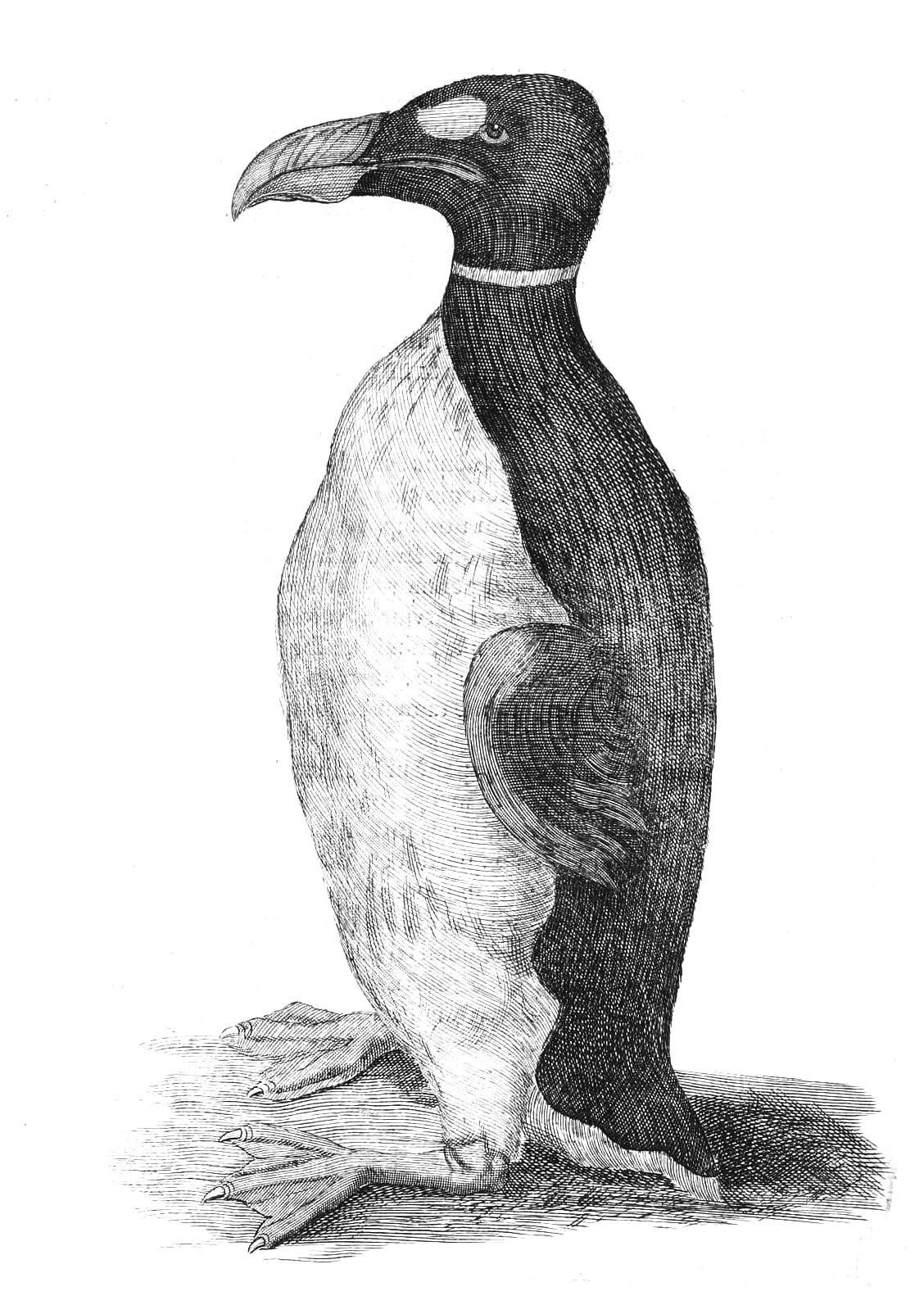
Looks a fuck of a lot like a penguin, wouldn’t you say? This is the only known illustration of a Great Auk drawn from life, and it was made based on …
… Ole Worm’s pet Auk, received from the Faroe Islands.
Meaning, this is literally the exact Great Auk I was reading about in the book!
Talk about the chances! Great book, by the way.
Fun little detail about Sjón, from his Wikipedia page:
He does most of his writing in an old fisherman's cottage in Reykjavik. Hanging on the wall inside are the rib and shoulder blade of a large whale that once beached and died a short walk away from the cottage. “If you’re here,” Sjón says of his writing cottage, “then you’re in the belly of the whale.”
Cool guy.